Women In Tech. Where are they?
Women comprise only 26% of the tech industry despite making up 57% of the professional workforce. Explore the barriers preventing women from pursuing careers in technology and solutions to increase representation.
By Katia Wheeler ·
Where are they?
It’s hard to spot us. Sometimes, you see long, flowing hair from a distance. You approach. Slowly, they turn, and to your dismay, you see the beard. Alas, it is not a female in tech but Jim from IT. Sadly, you retreat to your corner and start furiously slamming your fingers across your mechanical keyboard.

While I’ve only been in the tech industry for three years, it doesn’t take long to realize that sometimes you are the only female in a room full of men. It can be lonely, intimidating, isolating, and discouraging. It also highlights a problem: Where are all the women?
What’s the problem?
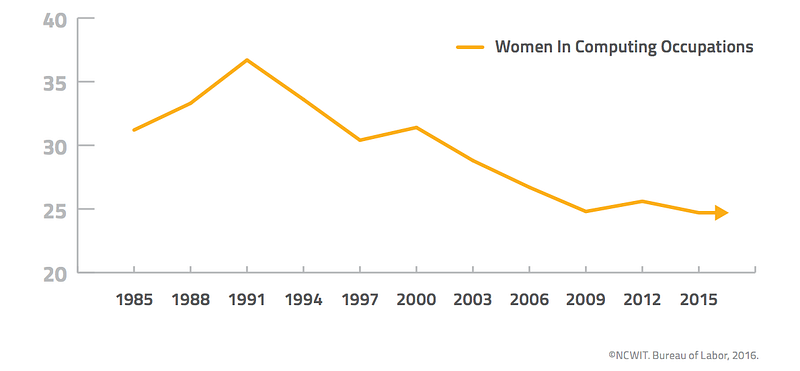
According to the National Center for Women & Information Technology’s By the Numbers report, in 2017 women made up 57% of the professional workforce but only 26% of the tech industry. In 2016, 57% of all Bachelor’s degrees were received by women with only 19% of the degrees being in Computer and Information Sciences. In contrast, 25% of the tech industry was dominated by women in 2015. In two years, we have only increased in number by 1% of the U.S. workforce in technology. That might seem like a victory, but it’s not.
Overall, the number of women in technology has been declining since 1991, when women held 36% of tech jobs. What’s even more interesting is that, according to Girls Who Code, roughly 74% of young girls present an interest in STEM fields and computer science while only 19% actually pursue a degree in these subjects.
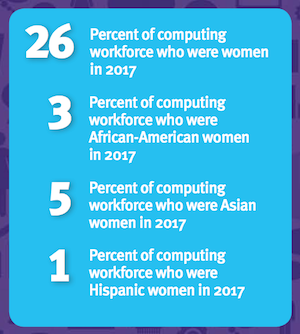
An even bigger issue is the diversity of women in STEM. While 26% of STEM positions were held by women in 2017, 17% of those positions were held by White Women while only 5% were held by Asian Women, 3% by Black/African American Women, and only 1% by Latina/Hispanic Women.
Why is this happening?
From my experience, STEM isn’t being talked about enough to young women as a potential career option. I don’t have a degree in Computer Science (le gasp!). When I was in high school, I was dabbling with VB.NET and knew HTML pretty well. I would write small, simple programs in my spare time. My mother was a German teacher and my father was a CPU architect for IBM. When it came time for me to choose what I wanted to do in life, not a single person told me that Computer Science was an option. I ended up getting a Bachelor’s in Music Education and teaching elementary music for two years before finally making the switch to technology. I am not alone.
Research by the National Girls Collaborative Project has shown that exposure to STEM and how technology can apply to a career at a young age can affect a girls attitude towards STEM subjects. Talking to girls about future STEM opportunities can encourage them to pursue math and science at the same rate that boys do. But what about the women who are currently in STEM fields?
In 2017, a (now) former Google software engineer released a 10-page memo about how women aren’t represented in technology careers not because of bias or discrimination, but rather due to an inherit psychological inferiority to men.

This perception is still prevalent in the workplace. Bias, including unconscious bias, and stereotypes are still a large problem for women who are currently in the tech industry or have the skillset to be. Workplace experiences are one significant factor in retention rates among women in technology. Women who left technology careers reported far less training, support, and far more undermining behavior from their managers in the workplace.
How can we stop the madness?
Organizations like Girls Who Code, Girl Develop It, and the National Girls Collaborative Project are making a great impact. These organizations provide amazing opportunities for girls to get hands-on experience with Computer Science in a safe, collaborative environment. This early exposure to STEM subjects boosts confidence and interest in girls at a young age.
Research by Million Women Mentors shows that having a positive role model is a primary motivator for girls exploring careers in the STEM field. You can apply to be a mentor and learn more about Million Women Mentors, regardless of your gender, on their website.
Lastly, if you have a daughter, talk to her about STEM career opportunities. Even if she doesn’t seem interested, it’s important to let her know that it is an option for her and to encourage her to pursue a career in STEM. Harvard found that after eight years of Computer Science training, women were just as confident as men with zero to one year of training, so it’s entirely possible that your daughter might just lack some confidence to kick ass.
Author’s note: I am a white woman in Kansas City. I do not speak for all women in technology and my experiences are only my own.
Originally published on Medium.